There's a test I'd apply to any automation consultancy, and it seemed only fair to apply it to ourselves: does your own firm run on the thing you sell?
As of this week, ours does. Sixteen n8n workflows run Marain's operations — lead research, follow-ups, content distribution, invoicing plumbing, monitoring — on a single small Hetzner box that also hosts our CRM. Here's the honest tour.
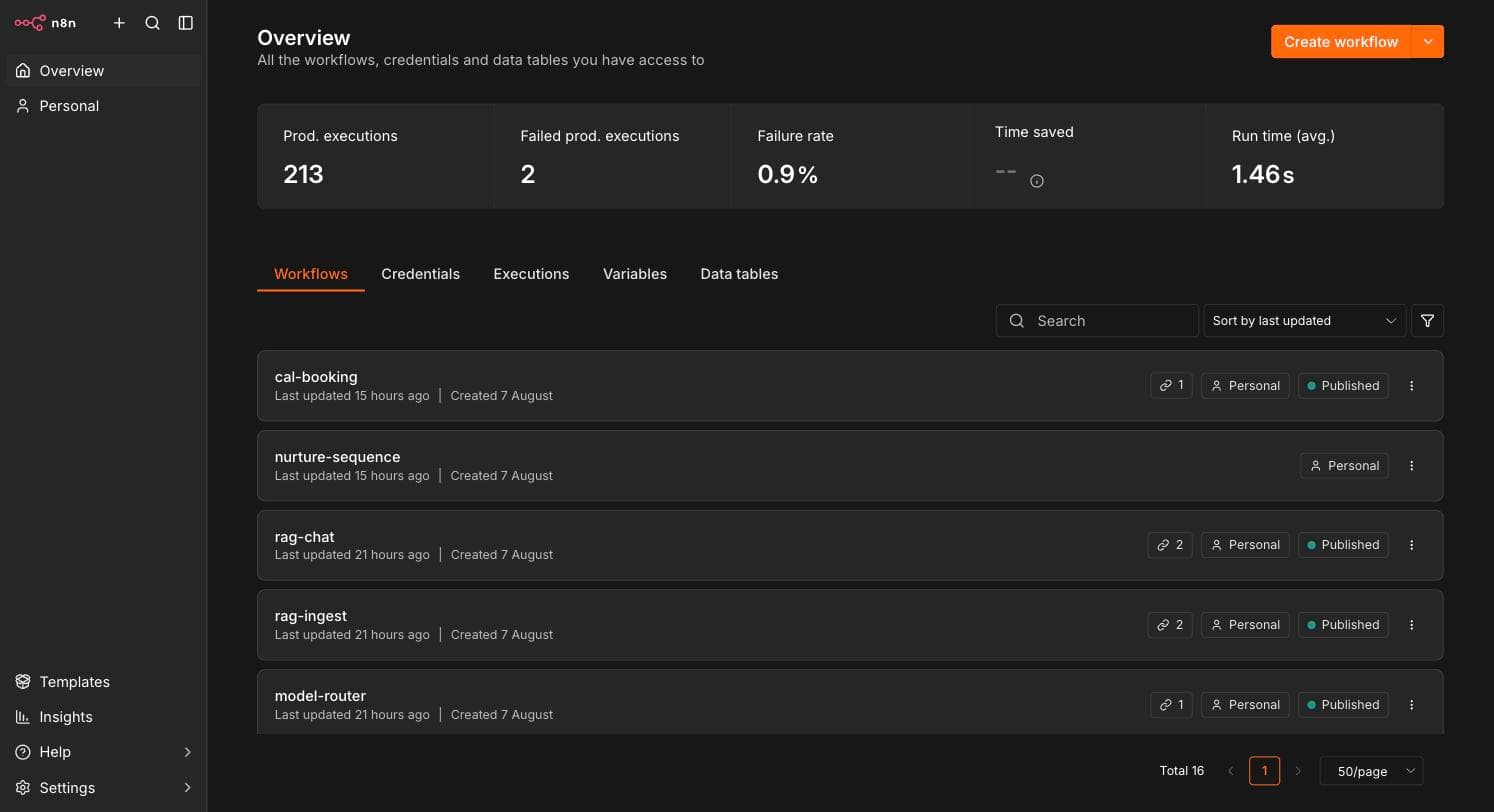
What actually runs
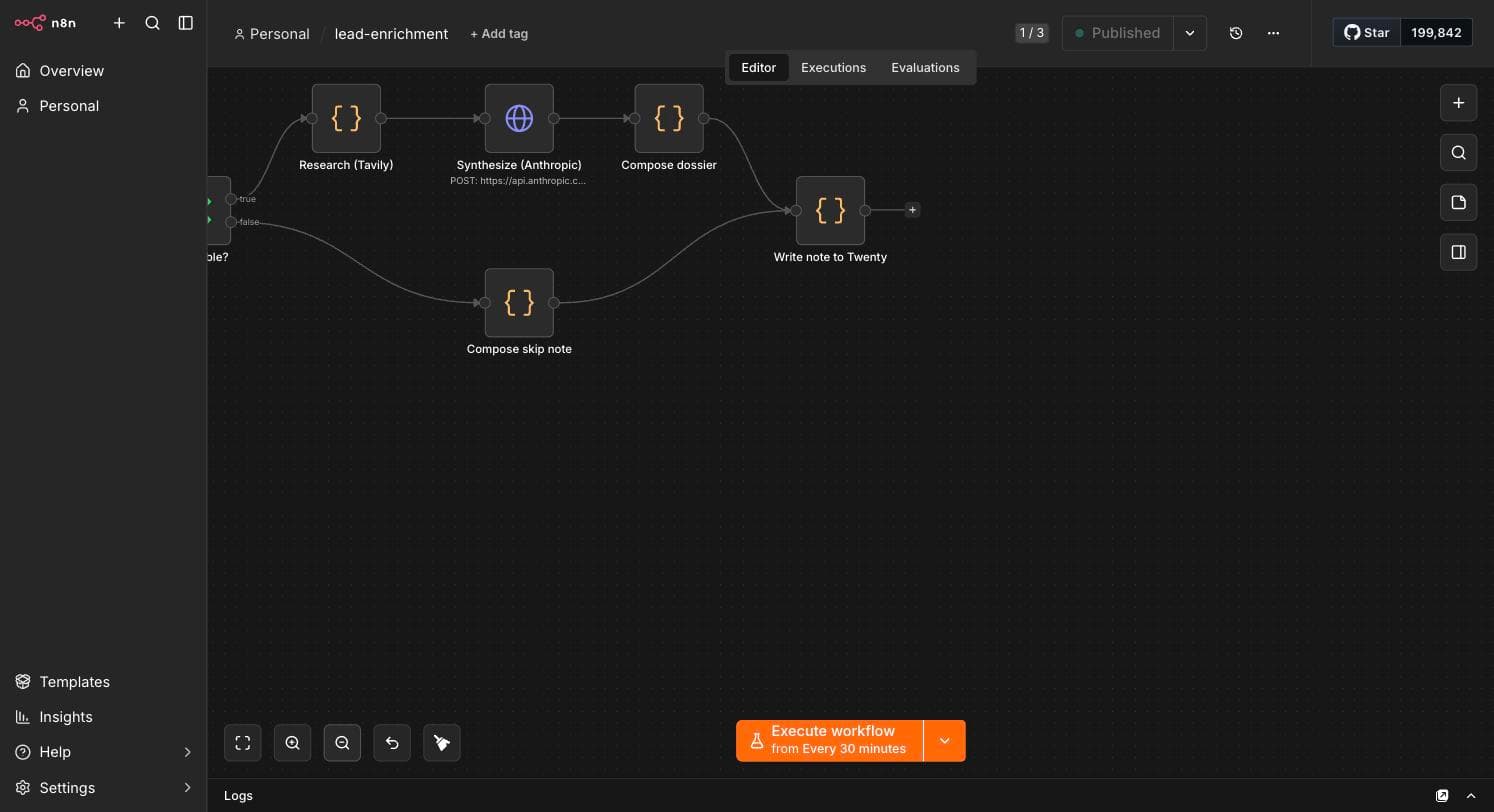
Lead enrichment. When someone uses one of our assessment tools, a workflow researches their company, scores the fit 1–5 against our ideal customer profile, and writes a dossier into the CRM before I've even seen the lead. The scoring includes negative signals — when we tested it against an AI infrastructure vendor, it correctly returned 1/5 with the note "direct overlap with the supply side, not a buyer." A research dossier that flatters everyone is worthless.
Meeting follow-through. A booking on our calendar advances the deal stage in the CRM automatically — which, crucially, stops the email nurture sequence for that person. Post-call, a transcript becomes a summary, action items, and a drafted follow-up email in my voice. The draft comes to me; I send it. Nothing ever goes to a client without a human clicking send.
Content distribution. A new post here becomes platform-specific LinkedIn and X drafts in my scheduler's queue — as drafts, behind an approval gate. Twice a week another workflow proposes a LinkedIn post and emails me Approve/Reject links signed with HMAC. A weekly workflow assembles a newsletter draft from what I've written and what's worth reading. None of it publishes itself.
Watching the watchers. Any workflow failure alerts my phone within seconds. Every night, all workflow definitions are exported to off-site backup alongside the database dumps. A daily health check verifies containers, disk, TLS certificate expiry, and that last night's backup actually landed. Boring — and the first thing I'd build again, because automation you don't monitor is a liability with a cron schedule.
The design rules that mattered
A few rules came out of building this that we now treat as non-negotiable:
- Human gates on everything outward. Drafts, approval links, review queues. The machine prepares; a person commits.
- Fail closed. Every webhook rejects unsigned requests. If a check can't run, the answer is no, not probably.
- State lives in durable systems. Workflow-engine memory is convenient and occasionally amnesiac. Anything that matters — "did we already email this person?" — is recorded in the CRM itself, where a restart can't erase it.
- Alerts go where bounces can't hide. We discovered that our own mail provider silently rejected certain approval emails (a brand name in the subject next to a button was enough to trip an impersonation filter). Every critical link is now mirrored to Telegram. If you only learn about delivery failures from silence, you won't.
- Opt-out is law, not preference. The nurture sequence re-checks consent at send time, every time. It also refuses to email anyone whose record can't prove opt-in.
What it costs
The server is about €8 a month and also runs our CRM. The AI usage is almost embarrassing to report: the daily social-listening digest costs roughly a cent, a researched lead dossier a few cents, an extracted invoice about $0.011. The expensive ingredient was never the compute — it's knowing what to build, in what order, with which failure modes handled.
One more thing worth saying plainly: these workflows were built by AI agents — directed, reviewed, and verified against the live system, with every outward-facing action held behind the gates described above. That's not a confession; it's the demonstration. Orchestrating AI to build reliable systems is the service.
If you want this shape of operation for your own firm, the audit is where every engagement starts, and it produces the ranked list of what's worth automating in your business. Or start with the free assessment tools the enrichment workflow is quietly watching.