When a buyer wants to know who does something well, a growing share of them now put the question to an answer engine before they type anything into a search box. Our own research into n8n's automation-template gallery flagged AI-search visibility monitoring, daily brand-mention queries scored for a mention rate and competitor share, as the clearest new buyer pain of 2026: seven gallery templates address it, five published this year. What Claude, ChatGPT or Perplexity actually say about a given mid-market company, when a buyer asks, is rarely something anyone at that company has checked.
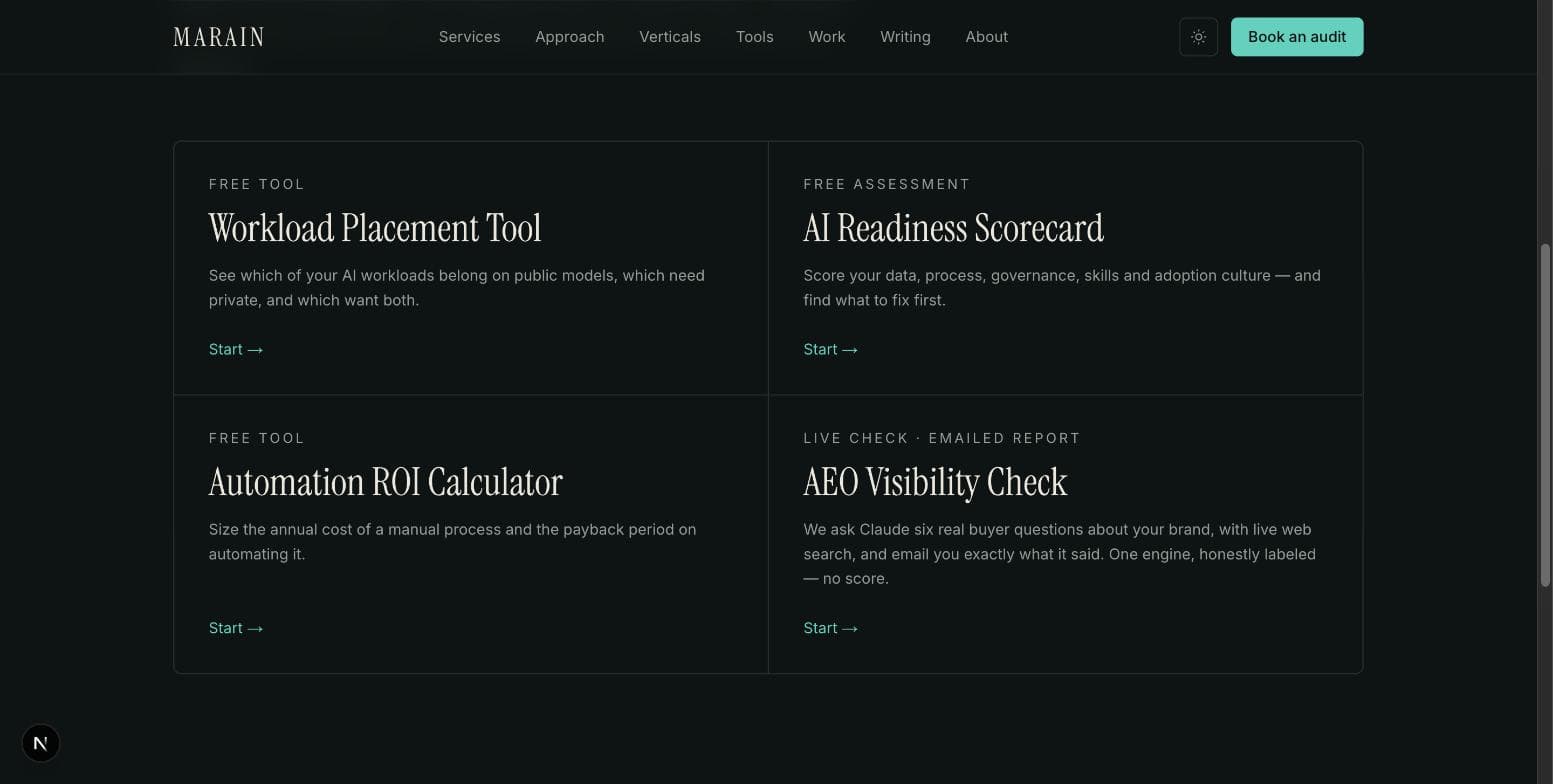
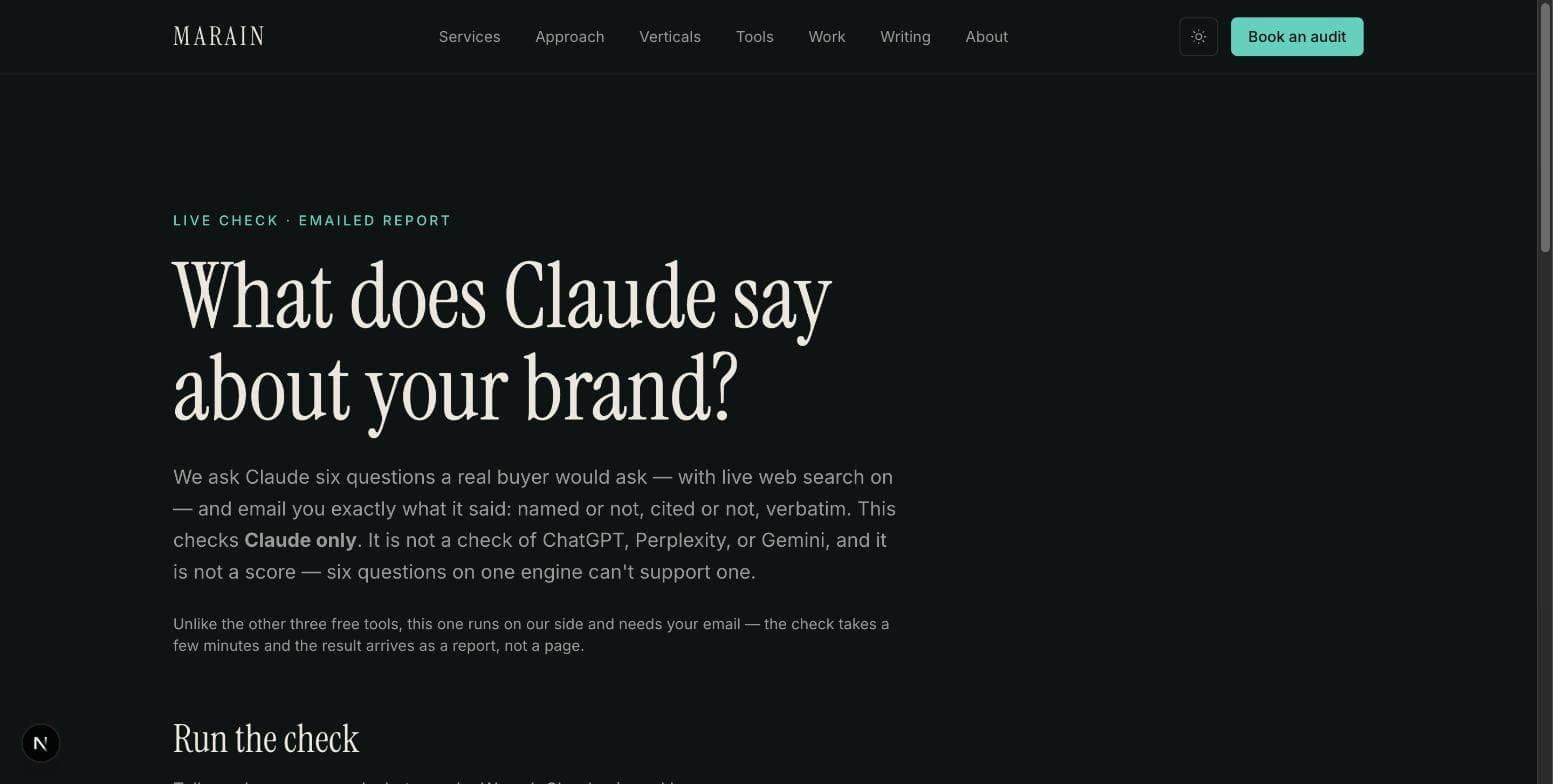
We built the buyer-facing version of that monitoring category as the fourth tool on /tools: /tools/aeo-visibility. A visitor enters a brand name, a domain, and a one-line description. Marain asks Claude six questions a real buyer would ask, with live web search on, and emails back exactly what it said.
The six questions
The check starts with one planning call: Claude Sonnet 5, searching only the visitor's own domain, returns a category description, an ideal customer profile, brand aliases, and three category questions. The six-question set is built around those three. Two ask about the brand directly: what it is, who it serves, whether it suits the ideal customer. Three are the planner's, in the site's own category language, along the lines of "best [category] for [buyer] in 2026." One asks who else a buyer should consider. Each question then gets its own Sonnet 5 call, web search open to the whole internet, because that is the search a real buyer would run. If planning fails, a fixed template set takes over, and the report says which set ran.
A question that times out or fails is recorded as not completed and dropped from the denominator, never folded in as a miss. The report's methodology line then reads "6 questions asked, 4 completed," and the two headline counts sit over that smaller denominator.
Verifying before reporting
What counts as a mention or a citation runs through code against the raw answer text, rather than a model's own summary of it. A mention is a case-insensitive match of a brand alias on word boundaries. A citation checks whether a URL on the brand's domain appears among the search results Claude used for that answer. Only the softer judgements go to a model: which competitors an answer named, and whether its framing reads positive, neutral, or negative. Even those get checked afterward: any competitor name or quote not present verbatim in the answer is discarded, and framing falls back to unclassified. A hallucinated competitor never reaches the report.
What arrives by email
The report opens with the exact methodology: which model, that web search was live, and the date. Below that sit the two headline numbers: named in N of M completed answers, cited as a source in N of M. A per-question breakdown follows, giving each question verbatim, its named and cited status, the sentence containing the first mention copied straight out of the answer, and the competitors and domains that answer surfaced. Every cited domain is then aggregated by frequency, often the most useful section, since it names the domains already owning the category. A limits block closes it out: one engine, one point in time, non-deterministic answers, and the risk of a false match on a common-word name.
Why there is no score
The other three tools on /tools, workload placement, AI readiness, and automation ROI, reduce what a visitor enters to a number. The AEO check reports two integers over a stated denominator and goes no further, because six questions against one answer engine cannot support a defensible index. Anything that looked like a 0–100 score would be manufacturing precision the check doesn't have. The report is explicit that it checks Claude only. ChatGPT, Perplexity, Gemini, and Google's AI Overviews are not asked, and the page says so rather than letting "AI search" stand in for one engine's answers. A second engine is a configuration addition rather than a rewrite, shipping once there's a paid key for it.
What we found checking ourselves
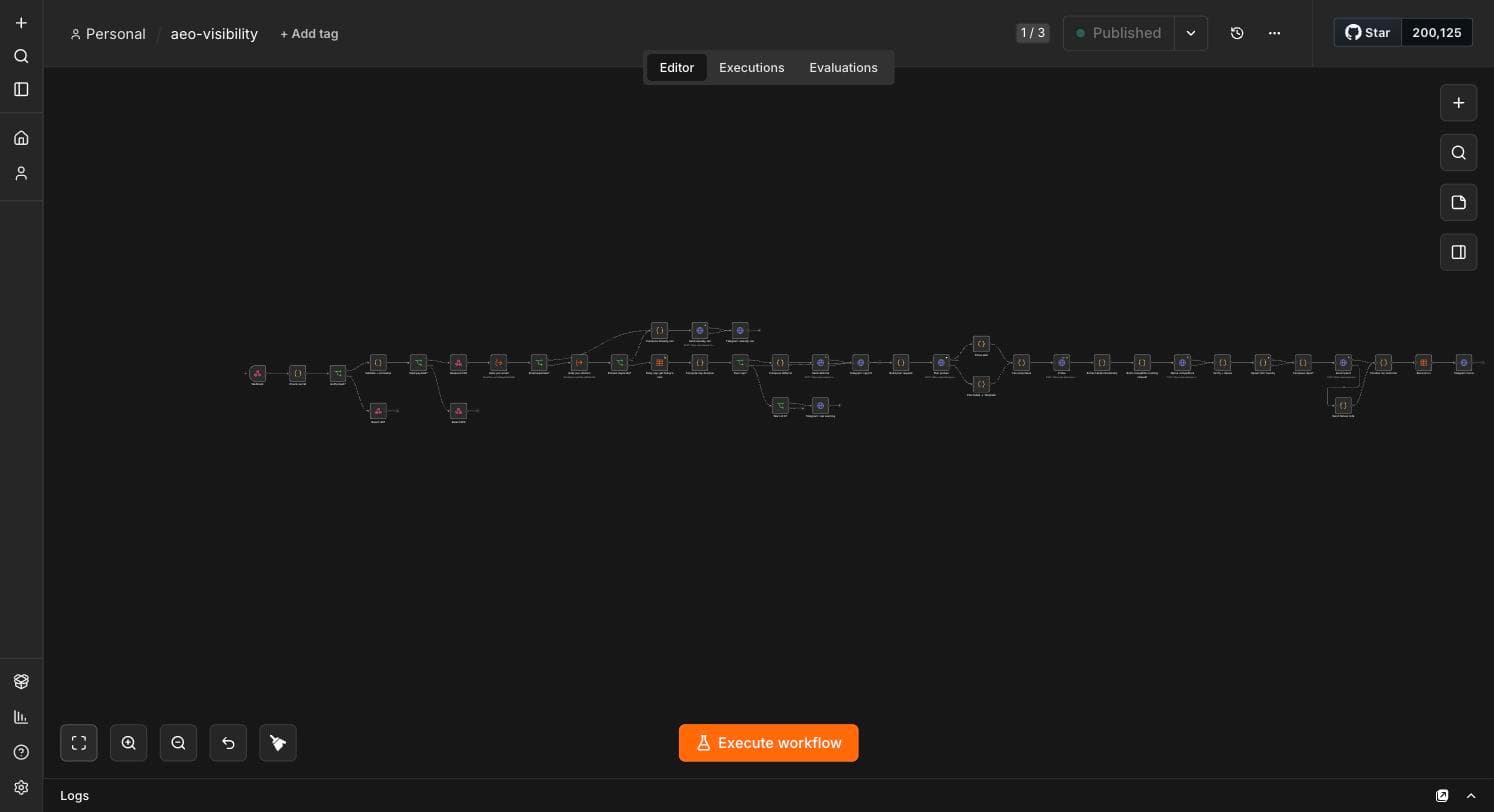
We ran the live check against marain.space itself before opening it up, as we test every workflow on the box.
The report came back named in 3 of 6 completed answers, cited in 0 of 6, band "thin." One answer read the domain as a fan project, reporting that Marain "appears to be a project centered on recreating and documenting the fictional" language Iain M. Banks invented for the Culture novels. Another said it "wasn't able to find any reliable, specific information about a company called 'Marain' in the AI/workflow automation space." All six answers cited something, 79 distinct domains between them, and not one of those domains was marain.space. The ones cited most often were Wikipedia and general AI-consulting roundups on intuz.com, tracxn.com and cbinsights.com, none of which mention us.
The run took 169.6 seconds end to end, and the report rendered cleanly in info@marain.space, our iCloud deliverability canary. Resend reported it delivered, no bounce.
Knowing what an answer engine tells a prospective buyer is easy to check and easy to keep putting off. The check is free, asks six questions, and reports only what happened: /tools/aeo-visibility. If what it turns up is worth acting on, the audit is where we start on the rest of it.